
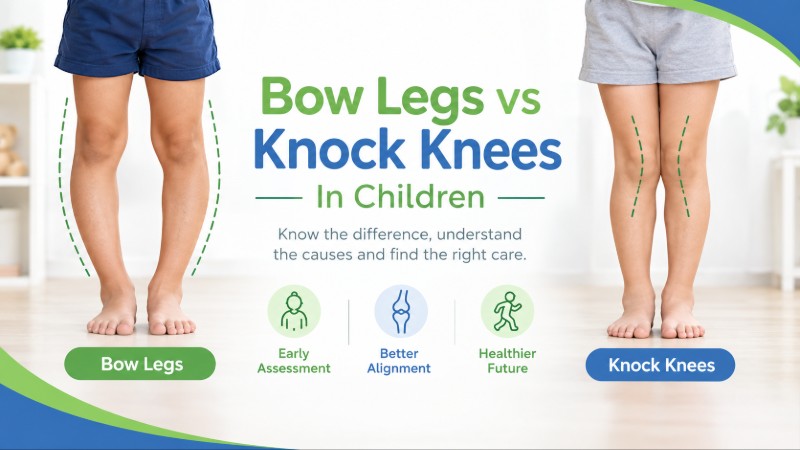
Children go through several stages of physical growth, and the alignment of their legs naturally changes as they grow. Parents may notice that their child’s legs appear curved outward or that the knees seem to move inward. These patterns are commonly described as bow legs and knock knees.
In many children, these conditions are a normal part of development and gradually improve without treatment. However, persistent, severe, asymmetric, or progressively worsening leg alignment can sometimes indicate an underlying bone or growth problem.
Understanding the difference between bow legs vs knock knees in children can help parents know what is generally normal and when to consult an orthopedic specialist.
What Are Bow Legs?
Bow legs, medically known as genu varum, occur when the legs curve outward. When a child stands with their feet together, the knees may remain separated.
A mild degree of bowing is common in babies and toddlers because of their position before and shortly after birth.
Common features of bow legs include:
- Legs curve outward from the knees
- Knees remain apart when the feet are together
- The appearance is usually similar on both legs
- It may be more noticeable when the child starts walking
In many young children, physiologic bowing gradually improves as the bones develop.
What Are Knock Knees?
Knock knees, medically called genu valgum, describe a condition in which the knees angle inward toward each other.
When a child stands with the knees together, the ankles may remain separated.
Knock knees are also commonly seen as part of normal childhood development. Many children develop some degree of inward knee alignment after the bow-legged stage.
Common features include:
- Knees appear closer together
- Ankles remain separated when the knees touch
- Both legs are generally affected
- The alignment may change naturally as the child grows
Bow Legs vs Knock Knees: Understanding the Difference
| Feature | Bow Legs | Knock Knees |
| Medical term | Genu varum | Genu valgum |
| Appearance | Legs curve outward | Knees angle inward |
| Typical observation | Knees remain apart | Ankles remain apart |
| Common developmental stage | Infancy and early toddler years | Preschool and early school years |
| Often symmetrical? | Yes | Yes |
| Usually requires treatment? | Often no | Often no |
The important point is that both conditions can be part of normal skeletal development. The child’s age, degree of alignment, symmetry, progression, and overall health should be considered before deciding whether evaluation is necessary.
What Is Normal During Childhood Development?
Leg alignment does not remain the same throughout childhood.
Infancy and Early Toddler Years
Many babies naturally have bow-shaped legs. This is often related to normal growth and their position before birth.
As children grow and begin walking, the legs usually become progressively straighter.
Preschool Years
After the bow-legged phase improves, some children naturally develop a degree of knock-knee alignment.
This may become more noticeable around the preschool years and can gradually improve with growth.
School-Age Children
By the later childhood years, leg alignment generally becomes more stable. Persistent or significant deformity at this stage may require an orthopedic assessment, particularly if it is worsening or associated with pain or difficulty walking.
When Should Parents Be Concerned About Bow Legs?
Although bow legs can be normal in young children, parents should consider medical evaluation when:
- The bowing is severe
- One leg appears significantly different from the other
- The condition is getting worse rather than improving
- The child experiences pain
- Walking is difficult or noticeably abnormal
- The bowing persists beyond the expected developmental stage
- There are concerns about the child’s overall growth
- The child is unusually short for their age or has other skeletal abnormalities
These features do not necessarily mean that a child has a serious condition, but they warrant professional assessment.
When Should Parents Be Concerned About Knock Knees?
Similarly, knock knees may be normal during certain stages of childhood. Medical evaluation may be appropriate if:
- The alignment is severe
- Only one leg is affected
- The condition is progressively worsening
- The child has persistent knee or leg pain
- Walking or running is significantly affected
- The knees remain markedly inward at an age when alignment would normally have improved
- There are other abnormalities in growth or skeletal development
An orthopedic specialist can determine whether the alignment falls within a normal developmental range.
What Causes Abnormal Leg Alignment?
Developmental variation is one of the most common explanations for bow legs and knock knees in children. However, persistent or unusual alignment can sometimes be associated with other conditions.
Possible causes may include:
- Nutritional deficiencies affecting bone health
- Certain skeletal disorders
- Growth-plate abnormalities
- Previous injury
- Metabolic bone disorders
- Genetic conditions
- Blount disease in some children with persistent bowing
The underlying cause cannot be determined from appearance alone.
How Are Bow Legs and Knock Knees Evaluated?
An orthopedic doctor will usually begin with a detailed medical history and physical examination.
The doctor may assess:
- The child’s age and growth pattern
- Leg alignment
- Symmetry between the two legs
- Walking pattern
- Height and overall growth
- Joint movement
- Presence of pain
- History of injury or illness
In some cases, imaging such as an X-ray may be recommended to evaluate the bones and growth plates.
Not every child with bow legs or knock knees needs an X-ray or treatment.
Do Bow Legs and Knock Knees Need Treatment?
Most developmental cases do not require treatment.
If the child’s leg alignment is part of normal growth, observation and regular follow-up may be sufficient.
Treatment depends entirely on the underlying cause and severity. If an underlying bone or growth disorder is identified, the doctor may recommend appropriate medical management.
Parents should avoid using braces, special shoes, exercises, or supplements without professional advice. Such measures are not routinely necessary for normal developmental alignment.
Why Early Orthopedic Evaluation Can Help
Parents often become concerned when they notice unusual leg alignment. An orthopedic assessment can help distinguish between normal developmental changes and conditions that require further investigation.
Early evaluation can be particularly useful when the alignment is:
- Severe
- Asymmetrical
- Painful
- Progressive
- Associated with difficulty walking
- Accompanied by abnormal growth
A timely assessment can provide reassurance when the condition is normal and help identify underlying problems when further treatment is needed.
When to Visit an Orthopedic Hospital in Etawah
If you are concerned about your child’s bow legs, knock knees, walking pattern, or overall bone development, consider consulting a qualified orthopedic specialist.
Parents looking for an orthopedic hospital in Etawah can seek professional evaluation rather than trying to determine the cause based solely on photographs or comparisons with other children.
A specialist can examine the child’s growth and leg alignment and recommend observation, investigations, or treatment when necessary.
Conclusion
Understanding bow legs vs knock knees in children can help parents recognize that changes in leg alignment are often a normal part of childhood development. Bow legs are commonly seen in infancy and early toddler years, while some degree of knock-knee alignment can occur later in childhood.
However, severe, asymmetric, painful, or progressively worsening alignment should be evaluated by an orthopedic professional. The child’s age, growth pattern, symptoms, and physical examination are more important than appearance alone when determining whether treatment is needed.
If you have concerns about your child’s leg alignment or walking pattern, Swadha Hospital can provide orthopedic consultation and evaluation to help determine whether the condition is part of normal development or requires further medical attention.